
Yes, you heard me right, they really do sell falcons.
Inside Doha’s Al-Mujadilah Centre: The World’s First Women-Mosque in Qatar
For Muslim travellers exploring Qatar, especially female travellers looking for meaningful spaces beyond the usual museums and malls, the Al-Mujadilah Centre & Mosque for Women in Doha is a refreshing and inspiring stop. Located in Education City, this newly opened complex isn’t just another beautiful mosque; it’s a history-making spiritual, intellectual, and social hub designed specifically for women.
While Qatar has invested heavily in architectural landmarks over the years, Al-Mujadilah stands out for something deeper: it reimagines what a mosque can be for Muslim women in the modern world.
Also read: 15 Must-Visit Places in Oman For Muslim Travellers
A mosque with a mission
From the beginning, the project was envisioned as a space where women can learn, worship, research, socialise, and contribute to Islamic knowledge, not just passively attend programs. The initiative was led by Her Highness Sheikha Moza bint Nasser, a long-time advocate for education and women’s leadership in the Muslim world.
Instead of the typical mosque model, Al-Mujadilah is intentionally designed as a civic institution, complete with:
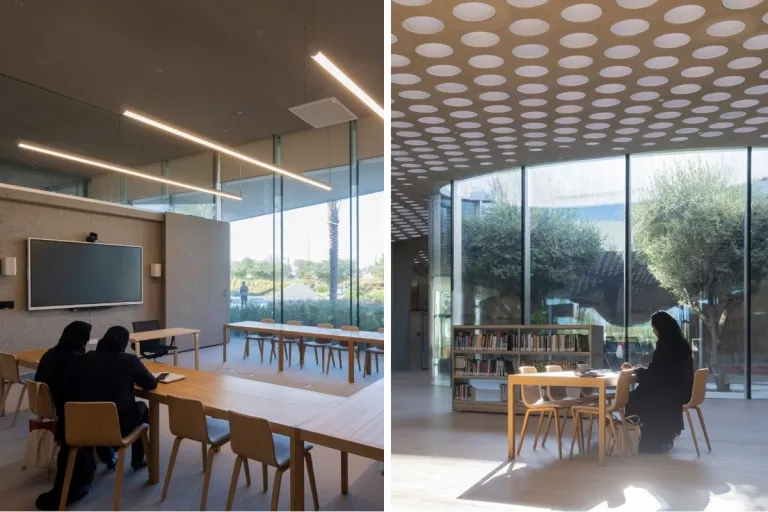
a dedicated library of 8,000+ books
classrooms and lecture halls
research facilities
café and social spaces
multi-purpose event rooms
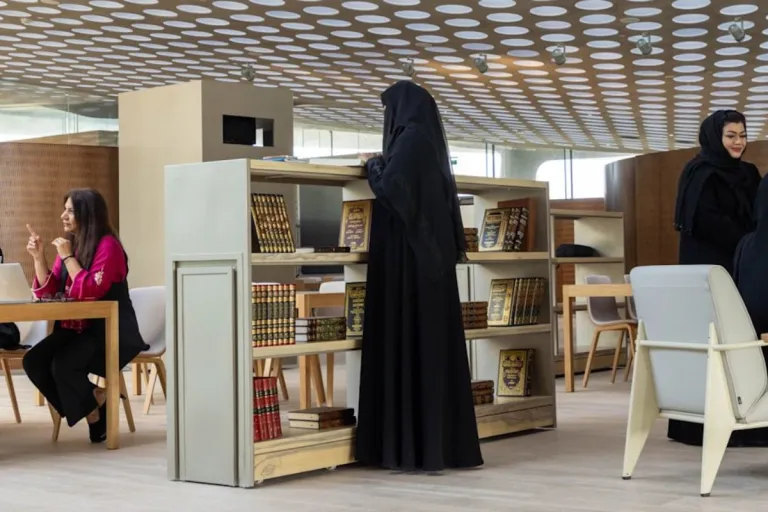
Image credit: Qatar Foundation Education City | Official Website
For female travellers, it’s a rare chance to witness a mosque built not only for prayer, but for thought, scholarship, and community-building.
Can men visit Al-Mujadilah Centre?
The mosque is mainly for women, so the prayer hall is only for female worshippers. Men cannot pray here, but they can visit for guided tours, architecture visits, or special programs.
The name with a story
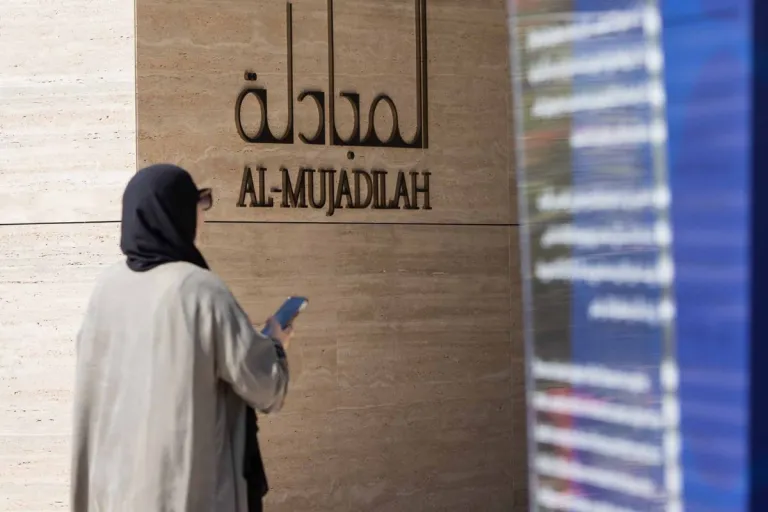
Image credit: Qatar Foundation Education City | Official Website
The name Al-Mujadilah references the 58th Surah of the Qur’an, Surah Al-Mujadilah, also known as “She Who Engages in Dialogue.” It recalls the story of Khawla bint Tha’labah, a woman who challenged an unjust pre-Islamic divorce practice and advocated for her rights directly to the Prophet Muhammad ﷺ.
The naming isn’t symbolic for symbolism’s sake; it aligns perfectly with the centre’s mission: a place where women engage, question, learn, and shape Islamic discourse.
Architecture that makes you stop and stare
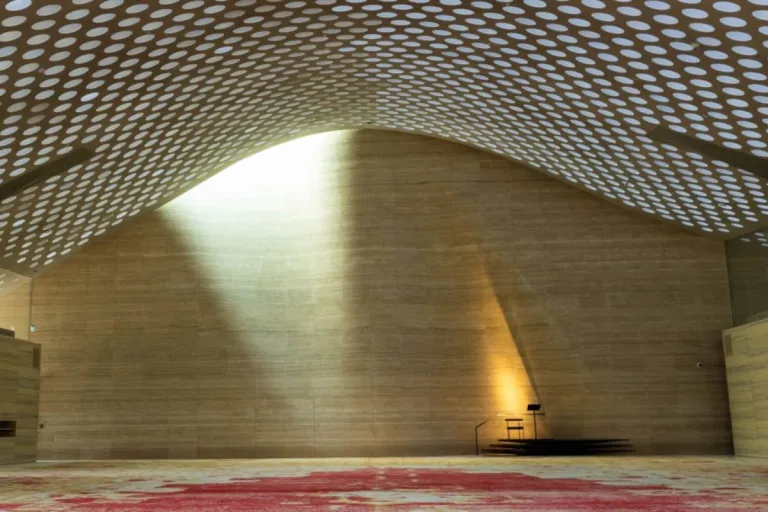
Image credit: Qatar Foundation Education City | Official Website
Designed by Diller Scofidio + Renfro (DS+R), the same studio behind some of the world’s most futuristic civic spaces, the mosque blends modern minimalism with Islamic geometry in a way that feels both sacred and contemporary.
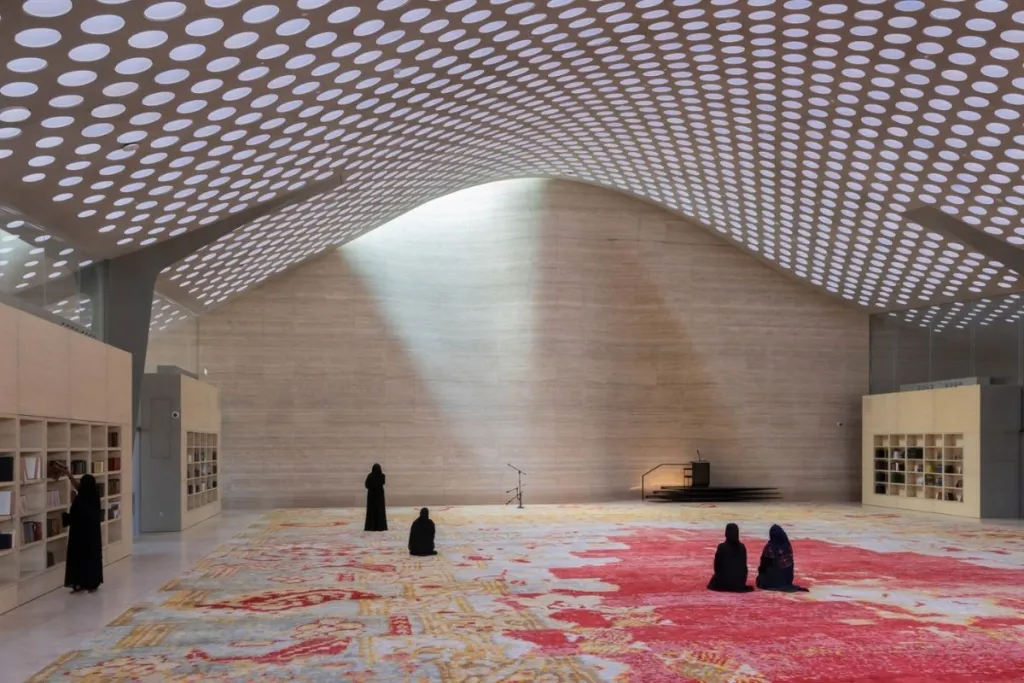
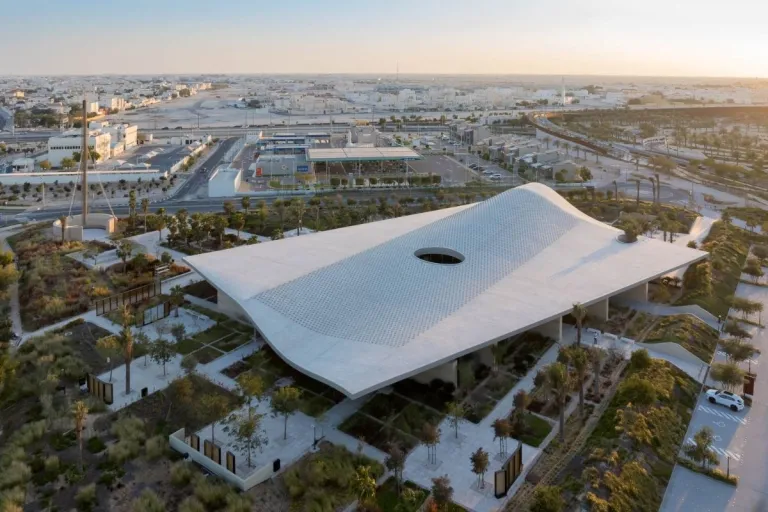
The star element is the signature roof, described by architects as a “hovering carpet.” Massive and undulating, it floats above the complex, providing shade and protecting from Qatar’s harsh desert heat.
The surface is perforated with 5,488 conical light wells that soften sunlight into a shimmering glow, allowing worshippers to pray in natural light without being exposed to the direct sun.
Inside the prayer hall, travellers will immediately spot:
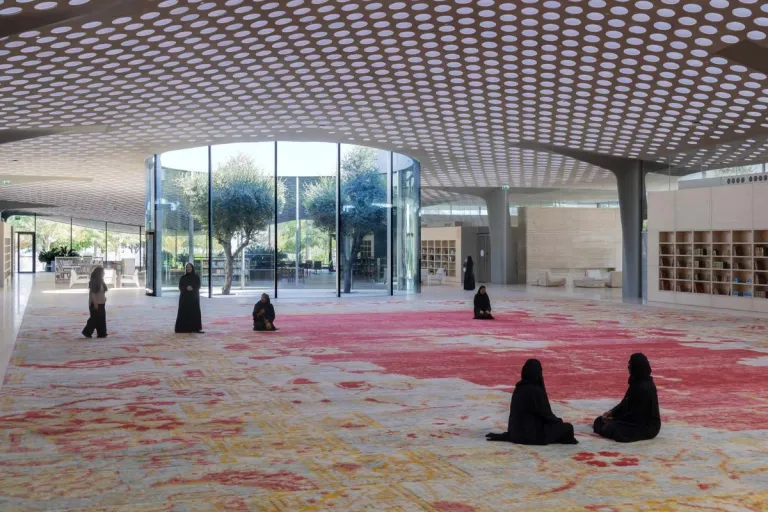
the curved Qibla wall
the custom 35m x 20m single-piece carpet
precise alignment to Mecca (rotated 17° from the building grid)
The hall seats 750 women, but the flexible layout expands capacity to 1,300 during Ramadan when the atrium and event spaces open up for taraweeh.
Also read: Top 10 Emerging Halal-Friendly Destinations for 2025
A minaret that moves
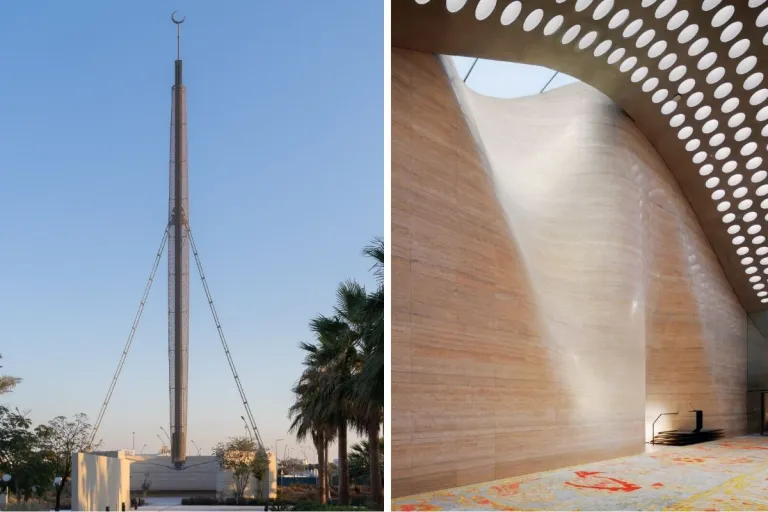
The minaret is unlike anything travellers may have seen elsewhere. Instead of a solid traditional tower, it takes the form of a 39-meter steel mesh tensegrity sculpture, slender, breathable, and almost poetic against the desert sky.
But here’s the twist:
Instead of a muezzin physically climbing the stairs, a cluster of speakers ascends and descends the minaret five times a day for the adhan. It's a modern reinterpretation of the call to prayer that honours the human tradition while using contemporary mechanisms.
Where nature is part of the worship experience

Al-Mujadilah is designed as an oasis, not a sealed facility. The building wraps around an oval courtyard where two olive trees push through the roof openings, a direct symbol of peace, resilience, and Qur’anic continuity.
Native plants (90% of landscaping species) and recycled water irrigation reflect Qatar’s growing commitment to sustainable design. The centre is aiming for LEED Gold and GSAS 4-star ratings.
For Muslim travellers used to city mosques or enclosed prayer rooms, this indoor-outdoor integration feels cooling, serene, and spiritually grounding.
A cultural & intellectual stop for travellers
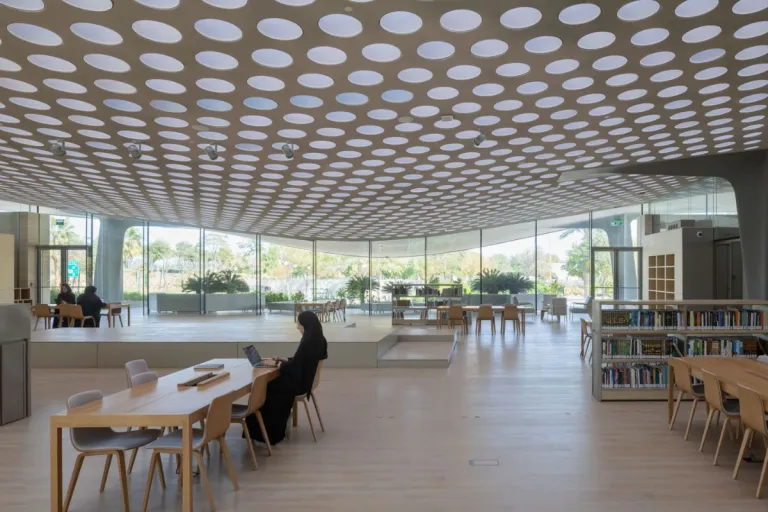
While the primary users are local women, the centre welcomes international visitors, particularly those curious about women-led Islamic spaces or architectural tourism.
Female travellers may find it interesting for:
Islamic history & scholarship
gender studies & Muslim discourse
architectural photography
cultural education
spiritual retreat
Researchers and students visiting Education City often stop by, and it’s an excellent addition to itineraries that already include:
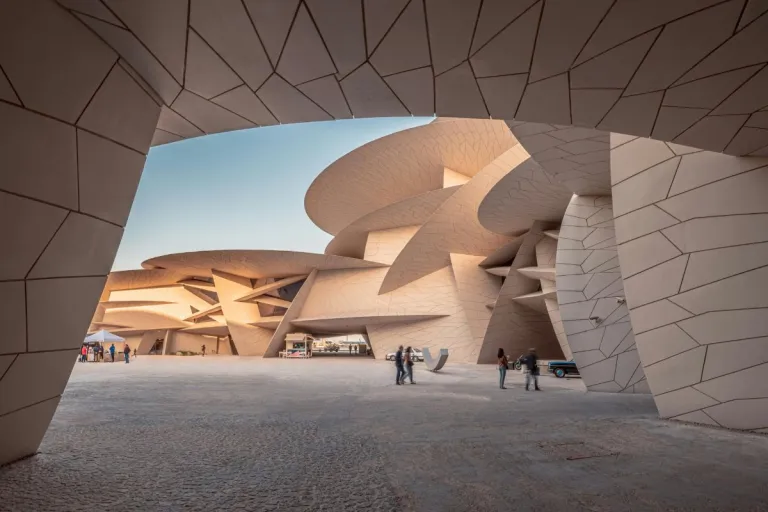
Image credit: Abdullah Ghatasheh | Canva Pro
Museum of Islamic Art
Mathaf: Arab Museum of Modern Art
Qatar National Library
Msheireb Museums
Why it matters for Muslim travellers
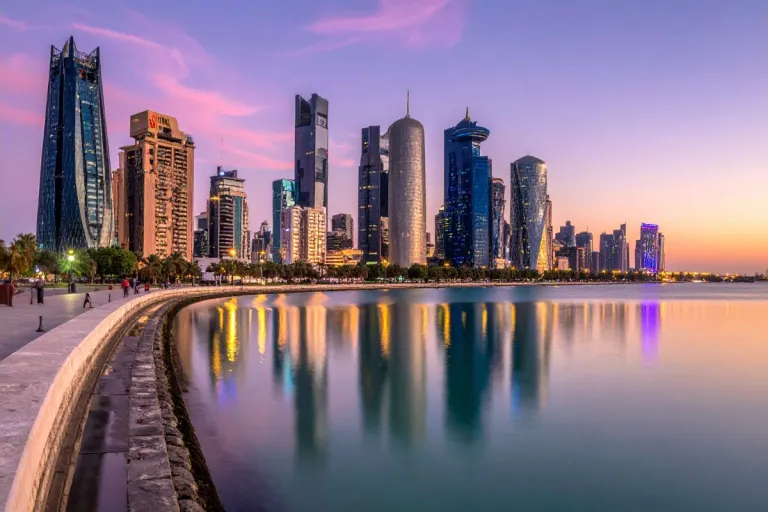 Image credit: IndahLestar29 | Canva Pro
For years, female Muslim travellers often struggled with limited prayer facilities; many mosques prioritise male spaces, while women’s sections are smaller, hidden, or less accessible.
Al-Mujadilah flips that script by showing a model where women are centred, prioritised, intellectually engaged, and spiritually empowered
It’s a space that proves something important: women are not guests in the mosque; they are stakeholders.
Also read: Malaysia’s First Umrah Cruise Launching January 2026: What to Know
A landmark for the future
In a world where Muslim women are constantly negotiating visibility, space, and representation, the Al-Mujadilah Centre & Mosque stands as a quiet but powerful statement.
For travellers, it offers more than sightseeing. It offers a look at what the future of Islamic architecture and women’s participation in spiritual and civic life can look like.
_________________________________________________________________
Image credits belong to Iwan Baan
Published at
About Author
Aimi Zulkiflee
Aimi is the ultimate daydreamer with a flair for adventure and an avid novel reader with a soft spot for all things fairytale. She is known for her friendly demeanor, albeit with a bit of a short temper. Forever striving to live her cutesy yet demure life.
Subscribe our Newsletter
Get our weekly tips and travel news!
Recommended Articles
Souq Waqif: The Iconic Qatar Market That Sells Everything From Spices to Falcons Halal Travel in China: Exploring Xi’an and Xinjiang From visiting mosques inspired by Middle Eastern architecture to exploring vibrant spice markets, there’s plenty of Muslim-friendly activities to do in Xi’an and Xinjiang!
Europe Can Wait: 10 Reasons Why You Should Plan a Stopover Trip in Doha The sophisticated charm of Doha makes it a destination which more than deserves to be on every traveller’s bucket list.
Qatar’s Tourism Gears Up for FIFA World Cup 2022 Qatar is boosting its tourist infrastructure as it prepares to host the prominent football tournament in 2022.
Qatar Unveils First Underground Railway For 2022 World Cup This week, Qatar is set to unveil its first-ever underground railway system to the public. As this Gulf nation prepares to host the World Cup in 2022, Qatar started its major transportation project six years ago. The railway system is aimed to run more than 75 trains through 37 stations by the year 2020. The […]
Latest Articles
Instagrammable Spots in Sabah, Malaysia Every Muslim Traveller Should Add to Their Bucket List Instagrammable Spots in Sabah, Malaysia. For Muslim travellers looking for beautiful places to explore and photograph
10 Beautiful Places in Batam, Muslim Travellers Should Visit Explore Batam home to beautiful beaches, tropical islands, green landscape for main gateways from Singapore
8 Best Halal Breakfast Spots in Batam, Indonesia discover 8 Best Halal Breakfast Spots in Batam, Indonesia from comforting noodles and \dim sum to classic batam dishes
10 Best Halal Restaurants in Macao for Muslim Travellers Explore 10 Best Halal Restaurants in Macao for a halal food hunt in Macao
Best Resorts in Sabah, Malaysia With Amazing Nature Views Discover the best resorts in Sabah, Malaysia, from beachfront escapes and island stays to rainforest retreats with stunning nature views